Category: Congregational Resourcing

  • Peace Corner

    Peace Corner

    This ‘Way,’ the mission of what it means to be a group of people following Jesus, our mission, is what the church must consider as we reimagine what it means to be church in our world today.

    (more…)

  • Jr. High Youth Rally

    Jr. High Youth Rally

    The District Jr. High Youth Rally will be held once again at Community CoB in Hutchinson (1600 N. Severance St. Hutchinson, Kan.), beginning at 6:00 p.m. on Friday, April 12 and going through noon on Sunday, April 14. (more…)

  • Peace Corner

    Peace Corner

    I find it difficult to create my own articles about peace issues, but it is relatively easy to find many other sources that have strong and inspiring words to share. I came across this article on Valentine’s Day and thought it worth sharing with all of you.

    Blessings and Peace – Terri
    WPD Peace & Justice Coordinator


    Essay by Rev.Irene Monroe
    February 14, 2019 

    I have chosen the Matthew 21: 12-17 text about Jesus turning over the tables of the money changers because I notice America is angry. And, with this anger I’ve noticed we have lost the ability and desire to “agree to disagree,” to talk across our differences; consequently, civil discourse has devolved. For so many, this story of Jesus turning the tables of the money changers becomes a non-apology for getting angry, for posting biting commentaries, and for online rants on divisive political issues, theological controversies and discussions on some polarizing social and cultural issues.

    Acts of violence and terrorism have increased as ways to make a point. And as a country we are imploding and we’re hurting each other.  Many of us, myself included, are disheartened and despondent seeing what is happening around us and to our country.

    Today, many folks don’t watch the news much unless related to work, because it can make you angry. I talk about anger all the time, but about “righteous anger” in the context of constructive activism, such as non-violent civil disobedience that is associated with Gandhi, Martin Luther King, and Jesus during their lifetimes.

    There is no better time than now to explore this topic of “righteous rage.” In the Matthew text, there are a diversity of opinions suggesting what Jesus was doing. Some scholars depict this text as the “temple tantrum,” saying Jesus just simply lost his cool. Others refer to it as “cleansing of the temple,” representing an attempt at reforming the temple. And, those with my hermeneutical lens see the text as an example of “righteous anger.”

    Jesus courageously confronted injustice. He challenged the temple’s hierarchy against the backdrop of the ongoing economic and social oppression of his times. Jesus was a non-violent revolutionary, but he was not passive. He regularly walked into the face of danger, spoke truth to power, and demanded justice. As far as religious people were concerned, Jesus was nothing but a nuisance and trouble-maker. He hung out with the wrong people, healed at the wrong time, visited the wrong places, and said the wrong things. His nonviolence was active, provocative, public, daring, and at times outright dangerous. Many of Jesus’ actions were illegal because he broke the law. He frequently committed civil disobedience in similar, if not the same ways, which we have come to know of Gandhi’s and MLK’s acts of civil disobedience. Many thought of Jesus as a one-man crime wave walking through the Roman Empire, beginning the process of disarmament wherever he went.

    So, to tackle this topic, I pose four questions: What is righteous anger? What have been examples of acts of “righteous anger” in your lifetime? Who embodied or embodies it? What should “righteous anger” look like today?

    Righteous anger is a holy discontent and indignation. It occurs when significant injustice exists, but it is always anger and indignation that is under control, and directed at the condition of injustice and not at a person. Righteous anger should attempt to teach rather than destroy the offender. It is unselfishness, wrapped in love, and does not involve revenge. It never uses guilt nor does it intend to humiliate, dominate or to control. In other words, righteous anger should lead to constructive actions and activism…..

    On every MLK holiday and during Black History Month, like now, the nation will honor Dr. King. However, King, like Jesus, was a revolutionary. He was thought of as one of America’s most dangerous. As a matter of fact, King was thought of as an agitator and angry black man, a racial trope now flung at Colin Kaepernick. King, however, ignored the criticism, evoking the rage of the Hebrew prophet Amos, who said: “let justice roll down like waters and righteousness like an ever-flowing stream.” King’s prophetic work of “turning over the tables” is because he saw America “in the wilderness,” divided along a color line violating the Fourteenth and Fifteenth Amendments of the U.S. Constitution that the federal government exerted little to no effort to enforce.

    Righteous anger allows you to see the faces of the damned, the dispossessed, the disinherited, and the disrespected, knowing that it is a starting place to begin the work of justice. The prophetic work of “turning over the tables” and fighting against the forces of injustice gave rise to King’s concept of the beloved community, because God is a God of love, and God is a God of justice. However, “turning over the tables” comes at a high cost.

    Is this really a battle we Christians want to take on?

    I pose this question because I have noticed America is angry and expressing it in unhealthy and dangerous ways. While I am nervous where we are in 2019, Jesus’, Gandhi’s, and King’s righteous anger free us to go out in the world to make a difference. My looking back at those times they lived gives me hope to look forward beyond this moment. As American Christians, we fail to realize that our gift is not fear, fighting, or hopelessness, but rather it is a righteous anger.

    If you don’t like where America is, then let’s change it. Martin Luther King said there are two types of leadership. There are those who are thermometers; they measure the temperature in the room. And there are those who are thermostats; they change the temperature.
    Let’s improve this moral climate we’re in and be thermostats.


    ~ Rev. Irene Monroe
    About the Author
    The Reverend Monroe is an ordained minister. She does a weekly Monday segment, “All Revved Up!” on WGBH (89.7 FM), a Boston member station of National Public Radio (NPR), that is now a podcast, and is a weekly Friday commentator on New England Channel NEWS (NECN). Monroe is the Boston voice for Detour’s African American Heritage Trail, Guided Walking Tour of Beacon Hill: Boston’s Black Women Abolitionists (Boston) – Detour

  • Peace Advocacy in the Western Plains

    Peace Advocacy in the Western Plains

    Once again, I find the writings of one of my favorite bloggers, Derek Maul, appropriate for expressing a vision of peace. Following is an excerpt from his Advent devotional booklet, “In My Heart I Carry a Star.”


    “And you, child, will be called the prophet of the Most High;

    for you will go before the Lord to prepare his ways,

    to give knowledge of salvation to his people

    by the forgiveness of their sins.

    By the tender mercy of our God,

    the dawn from on high will break upon us,

    to give light to those who sit in darkness and in the shadow of death,

    to guide our feet into the way of peace.”

    Luke 1: 76-79


    John the Baptist’s father, Zechariah, saw the Advent of the coming Christ as a clarion call to peace: Jesus as our guide; the tender mercies of God breaking open like the dawn; real light made evident where things had once been grim and dark. Forgiveness of sins would counter the shadow of ongoing defeat. What a vision, and what an inspiration!

    But what on earth have we been doing here in this twenty-first century? What have we been up to, to demonstrate that we have chosen to follow Jesus? How do we participate actively in this vision and bring healing peace into the reality of our world?

    A lot has been said about peace during this most turbulent past hundred years. There have been speeches, poetry, and folktales; countless hopes; beautiful dreams; and innumerable songs. But reality reveals a tragic contradiction. The more we talk about peace, the less tranquility and harmony we seem to actually witness.

    My grandparents would tell stories about 1918, when millions of people stood in throngs on Armistice Day, both in London and around the world. It was a stirring sight, they said, and they cried passionately with all their hearts, “Never again!” And they believed it.

    In my hometown of Folkestone, in the south of England, the hill the boys marched down on their way to the ships was later named the Road of Remembrance. But what did we all remember?

    We remembered so poorly that, even though President Wilson won the Nobel Peace Prize for his efforts to establish the League of Nations in 1919, the U.S. government neither ratified the charter nor joined the organization. We remembered so poorly that the world went at it again, just two decades later. We killed one another off by the tens of millions. As Europe hurtled toward war in 1938, Britain’s prime minister, Neville Chamberlain, signed the Munich Agreement. He desperately wanted things to be different, and he declared “peace in our time.” But it was more like whistling in the dark, a move that virtually guaranteed a more devastating confrontation. He did not understand that real peace has nothing to do with fear.

    Unless we find a way to actively engage “the tender mercy of our God,” and then make sure it really does break in like the dawn (Luke 1: 78), our failed attempts at peace are always going to fall short and only be added to the list of hopeless clichés. In the 1960’s, flower children stuck flowers in the barrels of National Guardsmen’s guns; meanwhile, other young people died in the struggle for Vietnam.

    Beatle John Lennon’s haunting plea to “Give Peace a Chance” became the anthem of a generation, but he was murdered by a dark soul frantic for attention and in serious need of God’s tender mercies. We all concur that the world needs to know a lasting and meaningful peace. Peace remains elusive and at best conditional and temporal in a world defined more and more by conflict and pain.

    What are we really talking about, then, when we throw the word peace around so easily yet so earnestly? The dictionary defines peace most notably in the negative. It’s a treaty to cease hostilities; it’s the absence of mental stress or anxiety. Peace is harmonious relations; it’s freedom from disputes; it’s the prevailing state during the absence of war; it’s the absence of armed conflict; it’s a kind of public quiet.

    Most of us buy into the “absence of” model on a regular basis. Have you ever walked into your kitchen and announced, at the top of your lungs “ALL I WANT AROUND HERE IS A LITTLE PEACE AND QUIET!!!”

    Jesus is the Prince of Peace; we can find the antidote to our most common misconceptions in the person, the actions, and the message of Christ. His beautiful way challenges us to see peace not as a negative or neutral condition but as dynamic, purposeful, and vigorous.

    The peace of God is not so much the absence of anything as it is the presence of so much. We can begin by inviting the tender mercies of our God to bring light into whatever darkness we find around us. We can be the presence of Jesus in this world. We can renew our commitment to God’s way. We can make a difference.


    Prayer:  Gracious God, author of our lives, thank you for your active and purposeful love. Wash us with the refreshing waters of your peace. Use us to bring that peace to our world. Challenge us to serve you faithfully. Amen.


    Blessings – Terri

  • WPD Workers Serve in Puerto Rico, More Needed

    David and Jane Sampson spent the first two weeks of November serving with Brethren Disaster Ministries in Castener, Puerto Rico.

    In January, Ric and Trudy Racine of Topeka will go for two weeks, and in March, Dean Holloway, Bud and Susan Taylor of McPherson and Curtis Rink of Wichita are scheduled.

    Jane reports a wonderful time among warm, hospitable people in a beautiful setting. Jane served as cook for the group of seven and found many ways to use bananas and cook in a crock-pot! Another highlight for Jane was reconnecting with her college roommate Janice Groff who lives in Ponce, PR.

    The other workers spent the first week roofing a house and were fortunate to attend a house blessing for the completed project in the second week. They also moved 400 cement blocks from one truck to another in preparation for another project and completed many small jobs.

    The Sampson’s worked alongside other volunteers including a young man from the Dominican Republic who wants to be a pastor and who served as a translator for them.

    Others who are interested in going should contact Terry Goodger at the BDM office. There are openings after April 12 and through August. Persons should be able to work in warm climates in a different culture. At this time, groups are limited to seven persons.


    Terry Goodger
    Rebuild Program Assistant
    Brethren Disaster Ministries
    410-635-8730
    tgoodger@brethren.org


  • Peace Advocacy in the Western Plains

    Peace Advocacy in the Western Plains

    Being Peace
    Richard Rohr’s Daily Meditation from Thursday, August 23, 2018
    From the Center for Action and Contemplation

    Paul Knitter has been an activist for peace and justice since the 1980’s. He is inspired by Engaged Buddhism, a term coined by Thich Nhat Hanh, which brings insights from Buddhist practice and teaching to social, political, environmental, and economic injustice:

    Buddhists are much more concerned about waking up to our innate wisdom and compassion (our Buddha-nature) than they are about working for justice. If Christians insist that “if you want peace, work for justice,” the Buddhists would counter-insist, “if you want peace, be peace.” That’s the point Thich Nhat Hanh gently drives home in the little book . . . Being Peace. His message is as simple and straightforward as it is sharp and upsetting: the only way we are going to be able to create peace in the world is if we first create (or better, find) peace in our hearts.

    Being peace is an absolute prerequisite for making peace. And by “being peace,” . . . [Thich Nhat Hanh] means deepening the practice of mindfulness, both formally in regular meditation as well as throughout the day as we receive every person and every event that enters our lives; through such mindfulness we will, more and more, be able to understand . . . whomever we meet or whatever we feel, and so respond with compassion. Only with the peace that comes with such mindfulness will we be able to respond in a way that brings forth peace for the event or person or feeling we are dealing with.

    This Buddhist insistence on the necessary link between being peace and making peace reflects Christian spirituality’s traditional insistence that all our action in the world must be combined with contemplation. . . . But the Buddhists are very clear: while both are essential, one holds a priority of practice. If action and contemplation form a constantly moving circle in which one feeds into the other, the entrance point for the circle is contemplation.

    I (Richard) personally believe the entrance point can be either action or contemplation. Most people act, love, sin, risk engagement, and make mistakes before they personally experience their own deep need for contemplation. Until you have “loved and lost,” your contemplation is often gazing at your navel instead of a passionate search for God and for your calling.

    Knitter continues:

    Why? Just why do Buddhists insist on the priority of Awakening over acting? Why do they want to “just sit there” before they “do anything”? Certainly, there are different ways a Buddhist might answer this question. But I believe that one of the recurring responses would be: to remove one’s ego from one’s peacemaking, so that one’s actions will not be coming from one’s ego-needs but from the wisdom and compassion that constitute one’s true nature.

    When we founded the Center for Action and Contemplation over thirty years ago, we envisioned spending half our time teaching contemplation and half teaching social justice. But for the same reasons Knitter gave, as well as the fact that most Western people are already geared toward action but need training in contemplation, we now spend much of our effort teaching various approaches to contemplation, knowing that if the inner world is authentic, an individual’s political, economic, and service attitudes will change organically from the inside out.


    Thanks for reading!

    “Seek peace, and pursue it.”  Psalm 34: 14b

    Terri Torres
    WPD Peace Coordinator

  • Brethren Disaster Ministries Update

    The St. Thomas Virgin Islands disaster recovery project has scheduled three work periods: June 17-30, September 9-22, and December 2-15.   

    There are 12 spots open each of the 2-week periods for volunteers from all districts on a first come basis. Housing, transportation, tools and meals will be provided during these 2-week time periods. Volunteers must be able to work in warm climates and some of the work during the June trip will likely include mucking and gutting homes.

    Partial reimbursement of airfare will be made available for persons who cannot fund their own travel.

    Please contact Bud and Susan Taylor if you are interested.

    Many thanks to Western Plains volunteers who served at the BDM site in Eureka, Missouri, which closed at the end of March. A new site working with UMCOR on Hurricane Matthew recovery in North Carolina has opened. Both the South Carolina and North Carolina sites will be housed at First Presbyterian Church In Lumberton, NC.  Our district has no plans to take a group, but if you are interested, please contact us as well.

    BDM does anticipate that there will be volunteer opportunities in Puerto Rico, but dates have not been set.


    Bud and Susan Taylor, District Disaster Coordinators

    taylorbud48@cox.net  620-245-4836

    susandtaylor@yahoo.com  620-245-4835

  • Haiti Medical Project Report

    Haiti Medical Project Report

    Submitted by Dale Minnich, Mission and Service Coordinator for Western Plains


    Following the massive earthquake in Haiti in 2010 the Brethren mounted a major disaster response, building nearly 200 homes.  Paul Ullom-Minnich participated in a medical team mission for a week, and became an advocate for a Brethren initiative to provide an ongoing response to meeting human need in Haiti.  By the end of 2011 such an initiative was underway and has received generous support from Western Plains District, especially by the McPherson congregation.


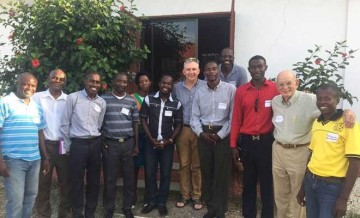
    An Evaluation and Learning Trip.  From January 14 – 22 a five person survey team held a day and a half of key meetings with the National Church of Eglise des Freres d’Haiti (the Church of the Brethren in Haiti) and with Haiti Medical Project staff and participated  in four and a half days of challenging travel to see projects and visit with local volunteers.  Team members included Jay Wittmeyer, Executive for Global Mission and Service; Dale Minnich, Volunteer Staff; Jean Bily Telfort, Director of Community Development; Vildor Archange, Director of Community Health and Pure Water Projects; and Dave Minnich, Team Photographer.


    Mobile Clinics Provide Direct Medical Care.  There were no clinics scheduled during our visit, but we consulted with Jean Altenor and Dr. Verosnel Solon of the Clinic Coordinating Committee.  As we enter 2018 the Coordinating Committee has resourced 235 clinics, providing approximately 40,000 patient visits in 23 communities!  Many of these visits have been with persons who have no other affordable access to direct care.  Forty more clinics are planned for this year.


    Promising Aquaculture.  An initial learning and demonstration project of aquaculture featuring both fish farming and related vegetable production has been established in recent weeks.  The initial project is located next to our guest house in Croix des Bouquets.  Through Haiti Medical Project we will facilitate learning from these early experiences as we prepare to ramp up use of this promising source of Haitian farm family income beginning in about a year.


    Pure Water Projects Expanding.  Three members of our community development staff and General Secretary Romy Telfort have received water technology training.  As we facilitated eight projects since 2015, our staff has become skilled in use of the related techniques.  In 2018 we are increasing the pace of pure water development and expect to facilitate at least 10 community projects this year.  We are currently launching new projects in Croix des Bouquets, Bohoc and Grand Bwa. To help with the additional work load of our staff we are seeking to fill a fulltime position as Field Staff Assistant, working largely in water project construction.  Helping provide pure water addresses the root causes of water borne disease, a leading cause of elevated infant mortality.


    The Raymonsaint Visit.  The first challenge was how to get there. Starting about 12 miles short of the community the road began to climb steeply and eventually virtually disappeared.  Our four wheel drive vehicle cleared fields of large rocks and eventually made it to the village, about 3,300 feet above sea level.  Haiti Medical Project had been in the remote community at least monthly over the past year, featuring the activities of a maternal care nurse and others working on a water project.  A number of volunteers from the community have received special training in community health.  Our nurse meets with mothers and young children regularly to weigh the babies, discuss improved nutrition and sanitation and focus on ways to successfully raise young children in this environment.  Evidences of malnutrition are found, and a program of nutritional supplements is being expanded.


    The community now has a small dispensary run by a local trained volunteer where community members can purchase the type of medicines that deal with such ailments as diarrhea, cough and colds, and other common complaints.  Can you imagine members of this remote community going to the drug store in Gonaives when a child is ill?  This illustrates for us the value of accessibility in providing services needed.  A pure water project featuring capturing rooftop water and installing a purification system also added to Raymonsaint’s efforts to provide a healthy environment.


    Expanding Community Health Work.  The maternal care work exemplified by the report of Raymonsaint was carried out in 11 communities this past year, including mothers

    clubs, a short course for the untrained community members who deliver the babies, and a rural dispensary.  The educational work with mothers reached over 600 mothers last year and related to many more children.  Next year we are adding five more communities and needing to add two part-time nurses—one in the southern peninsula and one at the northern coast, and hope to reach nearly 900 mothers monthly.


    Our whirlwind tour also touched briefly:

    • Louis du Nord, where the Brethren have a significant presence including a school for 560 students and two Brethren congregations. We have worked with them with a school nurse and a large water project and are expanding into community health ministries in 2018.
    • Perise, where we encountered our maternal care nurse and a trained local volunteer at work with a group of assembled mothers and babies.
    • Gonaives, where we stopped briefly to view their recent work to purify their water through a reverse osmosis system, with help from our team.
    • Cap Haitien, where we looked over an existing well that can be improved and made more suitable as a supply for drinking water.
    • Ouanaminthe, a border town with Dominican Republic, where we visited with the local pastor and congregational leaders and tested the water.
    • Bohoc, where we met Pastor Georges Cadet and a group of his leaders as we discussed an upcoming congregational project to provide a cement floor for their church building and a plan for a Haiti Medical Project water system there later this year.
    • A visit to a 1-2 acre plot of rented irrigated land that will be a support for a new program in 10 communities in agriculture, soil conservation and reforestation.


    Beginning in 2011 we formed a Haitian mobile clinic team of three doctors, four nurses, a coordinator and a driver.  In 2015 we added a community development team of 8 persons to work at community health, pure water and agriculture.  This team consists of four field leaders, two maternal care nurses and two school nurses and is being expanded for 2018.  We have an excellent and dedicated staff.


    The little shoe string operation begun in late 2011 through an international dinner at the McPherson congregation now has an annual budget of about $325,000 including good support from a very helpful endowment fund of about $450,000.  God is good!

    Haiti rain barrels


    System at Raymonsaint to harvest rain water from the church roof into a cistern and using sand biofilter purification..


    Meeting of the survey team with 8 members of the National Committee
    (photographer Dave Minnich not shown)

    Haiti Medical Project 2018


  • BDM in Eureka, MO

    Submitted by  Susan & Bud Taylor

    Despite snow and cold, four Western Plains Brethren came to Eureka, Mo, to help get persons displaced by the December 2015 floods back into homes.

    Jean and Francis Hendricks-McPherson, Curtis Rink-Wichita, and Ben Patrick-Monitor, worked the week of January 14, helping with dry wall, painting, cooking, plumbing, and other tasks.

    Project leaders for the month were Bud and Susan Taylor-McPherson, and Harry and Phyllis Hochstetler-Colorado City.

    A house blessing for a completely remodeled trailer highlighted the week.  The resident, a woman displaced for more than two years, was given a quilt made by a Southern Ohio church.

    This is the second week a Western Plains group worked in Eureka.  Ten from our district served the first week in December.  The project there will close before Easter.

    BDM pic

  • Men’s Retreat

    Men’s Retreat

    Plan now to attend the Western Plains District Men’s Retreat, which will be held April 20-21, at the Heartland Center for Spirituality in Great Bend, Kan.
    Registration deadline March 20

    Title: “Your Kingdom Come…”

    Hosted by the men of the Quinter CoB along with pastor Keith Funk

    Click here for Registration Forms & Invitation Letter